
Researching the Napoleonic Wars: Why Chat-Based AI Falls Apart on Complex Topics
The Problem With "Tell Me About the Napoleonic Wars"
You open ChatGPT. You type: "Help me understand the Napoleonic Wars."
The AI responds with a competent summary. Dates. Major battles. Napoleon's rise and fall. Maybe 800 words of solid encyclopedia content.
But here's the thing: you didn't want a summary. You wanted to research.
And research isn't linear. The Napoleonic Wars aren't a single story—they're a web of interconnected threads: military strategy, economic warfare, political coalitions, technological innovation, cultural shifts, colonial implications. Each thread branches into dozens more.
How do you explore all of that in a chat window that only shows you one response at a time?
The Scroll of Doom: What Happens in Traditional AI Chat
Let's trace a typical research session in ChatGPT or Claude:
Prompt 1: "What were the main causes of the Napoleonic Wars?" Wait 30 seconds. Read. Scroll down.
Prompt 2: "Tell me more about the Continental System." Wait. Read. Your previous context is now above the fold.
Prompt 3: "How did Britain respond economically?" Wait. Read. You've now scrolled past your first two responses.
Prompt 4: "Wait, go back—what about the military alliances? The Coalition Wars?" You're switching topics. Your previous thread is abandoned.
Prompt 5: "Actually, I also want to explore Napoleon's tactics at Austerlitz..." Another branch. But the chat doesn't show branches. It shows a scroll.
Twenty prompts later, you're drowning in a single vertical thread. The economic analysis is buried somewhere in the middle. The military strategy discussion got interrupted. You have no visual map of what you've explored vs. what remains unexplored.
You've created a research document, but you can't see its structure.
The Real Structure of Historical Research
Here's how a historian actually thinks about the Napoleonic Wars:
Napoleonic Wars (1803-1815)
├── Causes
│   ├── French Revolutionary legacy
│   ├── Napoleon's ambitions
│   └── British-French rivalry
├── Military Campaigns
│   ├── Austerlitz (1805)
│   ├── Peninsular War (1807-1814)
│   ├── Russian Campaign (1812)
│   └── Waterloo (1815)
├── Economic Warfare
│   ├── Continental System
│   └── British blockade response
├── Coalition Politics
│   ├── Third Coalition
│   ├── Fourth Coalition
│   └── ... through Seventh
└── Legacy & Impact
    ├── Spread of nationalism
    ├── Napoleonic Code influence
    └── Redrawing of European borders
This is a tree. A branching structure. At any moment, you might want to dive deeper into "Russian Campaign" while keeping "Economic Warfare" open for later exploration.
A linear chat interface forces this tree into a single vertical scroll. The structure—the most valuable part—disappears.
What You Lose in Linear AI
Let's be specific about what traditional AI chat interfaces cost you:
1. Spatial Awareness
In a chat, you can't see "where you are" in your research. Are you deep in military tactics? Economic policy? You don't know without scrolling back up—and scrolling disrupts your current thought.
In branching research, your position is visible. You can see: "I'm currently exploring Austerlitz, which is under Military Campaigns, and I haven't touched Economic Warfare yet."
2. Parallel Exploration
You're reading about Napoleon's tactics at Austerlitz. A question pops up: "How did this compare to Wellington's approach at Waterloo?"
In ChatGPT or Claude, you have two choices:
- Interrupt your current thread (losing context)
- Hold the thought in your head (cognitive load)
In a branching interface, you simply open a parallel branch. Both explorations run simultaneously. Both are visible.
3. Research Completeness
After an hour in ChatGPT, can you confidently say you've covered all major aspects of the Napoleonic Wars?
No. Because you have no map of what you've explored. You might have asked about Austerlitz three times (it kept coming up) but never touched the Peninsular War.
A visual branch structure shows you gaps. Unexplored branches are visible unexplored branches.
4. Return and Continue
You researched the Napoleonic Wars yesterday. Today you want to continue from "Coalition Politics."
In a chat interface, you scroll through hundreds of messages trying to find where you left off. Then you try to give the AI enough context to continue. Often, you just start over.
In a branching interface, you click on the "Coalition Politics" branch. Everything is where you left it.
A Side-by-Side Comparison
| Aspect | ChatGPT / Claude | Prismer |
|---|---|---|
| Interface | Linear chat scroll | Visual branching tree |
| Exploring multiple threads | Sequential only | Parallel branches |
| Seeing research structure | Hidden in scroll | Always visible |
| Tracking what's unexplored | Manual mental tracking | Visual gaps in tree |
| Resuming later | Scroll + re-explain context | Click branch, continue |
| Cognitive load | High (hold threads in memory) | Low (externalized to UI) |
See It In Action: Prismer's Learning Path
Here's what researching the Napoleonic Wars actually looks like in Prismer:
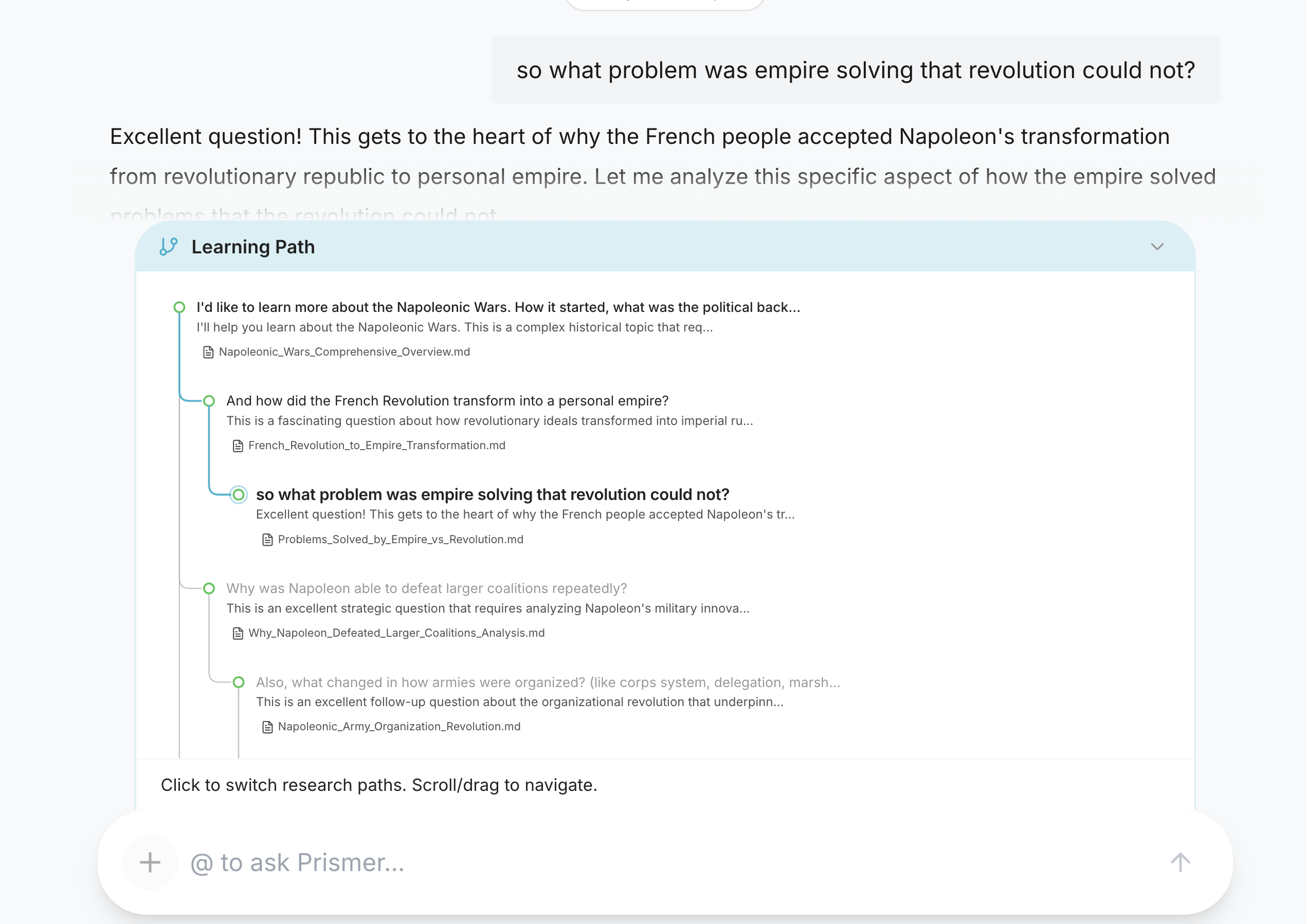
Notice what's happening here. This isn't a chat log—it's a Learning Path. Each question branches from the previous one, and you can see the entire structure at a glance.
Key Features Visible in This Interface:
1. Visual Branch Connections
The teal lines show how each question relates to its parent. "And how did the French Revolution transform into a personal empire?" branches from the original question about Napoleonic Wars. "So what problem was empire solving that revolution could not?" branches from that. You can trace the logical flow of your inquiry.
2. Auto-Generated Research Reports
See those .md files attached to each branch? (Napoleonic_Wars_Comprehensive_Overview.md, French_Revolution_to_Empire_Transformation.md, etc.) Prismer doesn't just answer your question—it generates structured research documents you can reference later. Each branch produces its own artifact.
3. Question Context Preservation
Each node shows both the question and a preview of what was explored. "This is a complex historical topic that req..." "This is a fascinating question about how revolutionary ideals transformed into imperial ru..." You always know what each branch contains without clicking into it.
4. Parallel Exploration
Look at the branches: one explores "Why was Napoleon able to defeat larger coalitions repeatedly?" while another asks "What changed in how armies were organized?" These are parallel threads—both visible, both explorable, neither interrupting the other.
5. Navigate, Don't Scroll
"Click to switch research paths. Scroll/drag to navigate." This isn't a document you scroll through. It's a map you navigate. Click any branch to jump there. Drag to pan across your research landscape.
Why This Matters for Serious Research
The Napoleonic Wars is just one example. The same problem applies to any complex research topic:
- Medical research: Disease mechanisms branch into genetics, environmental factors, treatment protocols, clinical trials...
- Technology analysis: "AI in healthcare" branches into diagnostics, drug discovery, administrative automation, ethics...
- Business strategy: Market entry branches into competitive analysis, regulatory requirements, localization, pricing...
- Academic literature reviews: Any thesis topic branches into theoretical frameworks, methodologies, prior studies, gaps...
Complex topics have branching structures. Linear interfaces flatten them.
The Fundamental Design Flaw
Here's the uncomfortable truth about ChatGPT, Claude, Gemini, and every other chat-based AI:
They were designed for conversation, not research.
Conversation is linear. One person speaks, then the other. Turn by turn.
Research is not linear. It's exploratory, branching, recursive. You go deep, then wide, then deep again in a different direction.
When you use a conversational interface for research, you're forcing a square peg into a round hole. The AI might be brilliant—but the interface limits how you can use that brilliance.
What Research Should Feel Like
Imagine researching the Napoleonic Wars and being able to:
- See your entire research tree at a glance
- Open multiple branches simultaneously (military tactics AND economic policy)
- Know exactly what you've explored and what remains
- Jump between branches without losing context
- Come back tomorrow and pick up exactly where you left off
- Let the AI suggest branches you haven't thought of
This isn't a feature request. This is what research naturally is. The only thing missing has been an interface that respects it.
Research the Way You Think
The Napoleonic Wars lasted 12 years and reshaped Europe. Understanding them requires exploration across military, political, economic, and cultural dimensions—all interconnected, all branching.
You deserve a tool that lets you explore the way your mind actually works: parallel, branching, visual.
Ready to research complex topics without losing your thread?
Try Prismer — where your research branches as freely as your thinking.